

How to Choose Skincare Products as a Beginner
Quick Summary
To choose skincare products as a beginner, first identify your skin type and your two or three main concerns, then pick a few well-understood ingredients that address them. Start with a cleanser, moisturiser and sunscreen, and add one targeted product at a time.
- Identify your skin type first: oily, dry, combination or normal.
- Pick two or three main concerns rather than fixing everything at once.
- Cleanser, moisturiser and sunscreen come first, then one targeted product.
- Patch test one new product at a time on the inner forearm or behind the ear.
- Leave a patch test for 24 to 48 hours and check for reactions before full use.
Table of Contents
- Start by Identifying Your Skin Type and Concerns
- Choose Skincare Ingredients for Beginners That Suit Your Needs
- How to Patch Test Skincare Products Before Full Use
- Start Your Routine With the Right Order to Apply Skincare Products
- Frequently Asked Questions
Start by Identifying Your Skin Type and Concerns
Last Updated: November 5, 2026
Learning how to choose skincare products as a beginner gets easier once you know what your skin actually needs. Dermatology guidance, including advice from the American Society for Dermatologic Surgery's guide to choosing skin care products, is clear: the most expensive product is not necessarily the best one for you.
Start by working out your skin type:
- Oily: shiny by midday, visible pores, prone to breakouts
- Dry: tight after washing, flaky patches, dull look
- Combination: oily T-zone with drier cheeks
- Normal: balanced, rarely irritated, few concerns
Next, list your main concerns, dryness, redness, breakouts or fine lines, and pick two or three. Fixing everything at once leads to overbuying.
Choose Skincare Ingredients for Beginners That Suit Your Needs
When you choose skincare products, ingredients matter more than brand names, and a short list of well-understood ones carries most beginners a long way.
What the core ingredients actually do
- Ceramides are lipids in the outer skin layer; they suit dry, tight or reactive skin.
- Hyaluronic acid and glycerin are humectants that draw water to the surface; seal them in with a moisturiser.
- Niacinamide is vitamin B3, often used for oiliness and uneven tone; many people start at lower strength.
- Salicylic acid is a beta hydroxy acid; it is often used for oily, congested skin, a few times a week.
- Retinoids are commonly used for fine lines and texture but can cause early redness and flaking, not a beginner's first purchase.
- Sunscreen filters are the active part of any SPF; look for broad-spectrum, high-SPF, water-resistant formulas if outdoors.
How to read an ingredient list without getting lost
Ingredients are listed in descending order until about 1%, so the first five or six tell you most of what a product is. Fragrance and essential oils usually sit near the end but commonly trigger sensitive skin, so scan for 'fragrance', 'parfum' and named plant oils if your skin reacts easily. Formulas change, so read the pack rather than an old review.
Matching ingredients to your main concern
- Dry or tight skin: ceramides, glycerin and hyaluronic acid in a cream or balm cleanser and a richer moisturiser.
- Oily or congested skin: a lightweight gel-cream, niacinamide, and salicylic acid a few times a week.
- Sensitive or reactive skin: fragrance-free, short ingredient lists, no acids or retinoids until basics are settled.
- Dehydrated skin: a hyaluronic acid serum under moisturiser while skin is damp.
- Uneven tone or fine lines: niacinamide first, then a low-strength retinoid once your routine is stable.
Prioritise before you buy
Cleanser, moisturiser and sunscreen come first, most work, least risk. Then add one targeted product for your main concern.
Watch out: a long ingredient list is not a sign of quality, and stacking multi-ingredient serums can make it harder to tell what helps and what irritates.
CeraVe Hydrating Cleanser 88ml →
The table below summarises the core ingredients and what each one does, so you can match them to your skin.
| Ingredient | What it does | Note |
|---|---|---|
| Ceramides | Lipids in the outer skin layer | Suits dry, tight or reactive skin |
| Hyaluronic acid | Humectant that draws water to the surface | Seal in with a moisturiser |
| Glycerin | Humectant that draws water to the surface | Seal in with a moisturiser |
| Niacinamide | Vitamin B3 for oiliness and uneven tone | Many people start at lower strength |
| Salicylic acid | Beta hydroxy acid | Often used for oily, congested skin a few times a week |
| Retinoids | Used for fine lines and texture | Can cause early redness and flaking; not a first purchase |
| Sunscreen filters | Active part of any SPF | Look for broad-spectrum, water-resistant formulas if outdoors |
How to Patch Test Skincare Products Before Full Use
A patch test is the step most beginners skip, and it prevents the most bad reactions. It is also the only reliable way to work out which product caused a problem.
A practical testing protocol
- Test one product at a time. Starting a cleanser, serum and moisturiser in the same week means you won't know which caused a reaction.
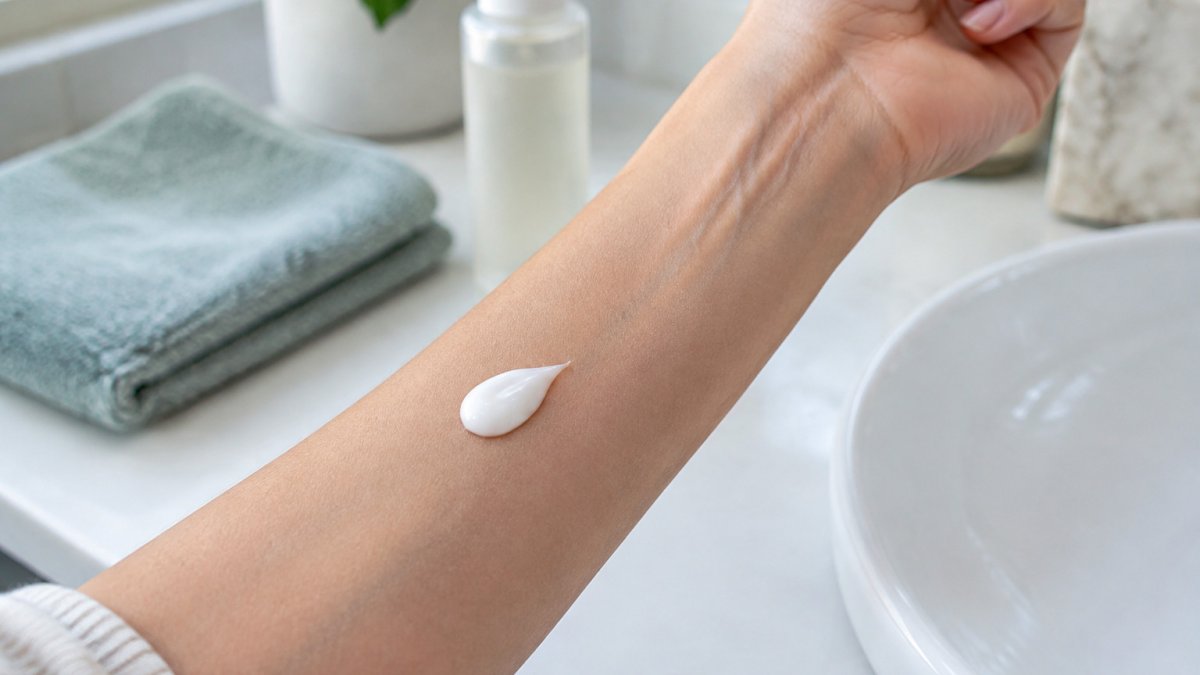
- Choose a test site. Apply about a five-cent coin's worth to the inner forearm or behind the ear.
- Leave it for 24 to 48 hours. Check at both points, because some reactions are delayed.
- Record what you used and when. A phone note with product name, date and any reaction is enough.
- Introduce one new product roughly every one to two weeks. Actives such as retinoids and exfoliating acids need up to four weeks before you judge them, because some early irritation is expected and settles.
- Stop if the test site stings, burns, swells or develops a rash. Mild tingling from an acid is common; pain, swelling or a spreading rash is not.
Reading the result
No reaction on the forearm does not guarantee your face will be fine, because facial skin is thinner and more exposed. If the patch test is clear, apply to a small area of the jawline for two or three days before using it across the whole face. Redness or flaking only where you applied it is useful information: reduce frequency, buffer with moisturiser, or set it aside.
When to seek professional advice
Most mild reactions settle within a few days of stopping the product. Seek assessment from a doctor or dermatologist if you have persistent acne that has not improved with a simple routine, a rash that spreads or blisters, swelling around the eyes or mouth, or irritation lasting more than a week after you stop.
Watch out: testing on the back of your hand is a common shortcut, but hand skin is much thicker than facial skin and often gives a falsely reassuring result.
Start Your Routine With the Right Order to Apply Skincare Products
A simple routine works better than a complicated one. Read How to Build a Minimalist Skincare Routine That Works to see how few products you actually need. Most beginners need only three steps:
- Cleanse: use the CeraVe Hydrating Cleanser 88ml morning and night.
- Moisturise: apply after serums or treatments, while skin is still slightly damp.
- Protect: finish your morning routine with sunscreen, such as the La Roche Posay Anthelios Invisible Fluid SPF 50+ 50ml.
Lighter products go on first and thicker ones last. Sunscreen is always the final morning step. For a fuller guide, see How to Build a Minimalist Skincare Routine That Works.


Frequently Asked Questions
How do I choose skincare products as a beginner?
Start by working out your skin type (oily, dry, combination, normal or sensitive) and your main concerns, such as dryness or breakouts. Then pick a small set of essentials: a gentle cleanser, a moisturiser suited to your skin type, and a broad-spectrum SPF 50+ sunscreen. Choose products with simple ingredient lists, check that each one suits your skin, and introduce them one at a time so you can tell what works. Avoid buying a long list of products at once, since that makes irritation hard to trace.
How do I know which skincare products are right for my skin type?
Look for labels that name your skin type, such as 'for normal to dry skin' or 'for oily and combination skin', and read the product description for the intended use. Products like CeraVe Hydrating Cleanser 88ml ($6.80 AUD) are designed for normal to dry skin, while CeraVe Oil Control Moisturising Gel Cream 52ml ($17.99 AUD) suits oily and combination skin. If your skin reacts easily, check the ingredient list for fragrance and choose products marked suitable for sensitive skin.
How can I tell if a skincare product will irritate my skin?
A common way to check is to patch test. Apply a small amount to a discrete area such as the inner forearm or behind the ear, once a day for several days, and watch for redness, itching, stinging or bumps. If nothing happens, you can try it on your face. Stop using the product if irritation develops, and keep an eye out for ingredients you have reacted to before.
